
Table of Contents
- What the Dental Implant Process Involves
- Step 1: Initial Consultation and 3D CBCT Scan
- Step 2: Bone Grafting and Sinus Lift If Needed
- Step 3: Placing the Titanium Implant Post
- Step 4: Osseointegration and Dental Implant Recovery Time
- Step 5: Fitting the Abutment and Final Crown
- The Cost of Dental Implants UK Patients Should Budget For
- Dental Implant Aftercare Advice for Long-Term Success
- Frequently Asked Questions
Last Updated: September 25, 2026
What the Dental Implant Process Involves
The dental implant process is a staged treatment that replaces a missing tooth root with a titanium post, then builds a crown on top of it. Most patients complete treatment across two phases: surgery, then healing, then the final restoration.
We walk patients through every stage before treatment starts. That way, nothing comes as a surprise.
A dental implant is a small, screw-shaped post placed into the jawbone to hold a replacement tooth. The bone fuses with the post over several months, which is what makes implants feel stable.
The full process usually follows five steps:
- Consultation and 3D CBCT scan
- Bone grafting or a sinus lift, if needed
- Surgical placement of the implant post
- Osseointegration and healing
- Abutment fitting and final crown
Each stage has its own timeline. Some patients need extra preparation. Others move straight to surgery.
Who Is a Suitable Candidate for Implants
Good candidates have healthy gums, enough jawbone to hold the post, and no uncontrolled health conditions that affect healing. Smoking and poor oral hygiene lower the success rate, so we discuss both before planning treatment.
Your periodontal health matters as much as bone volume. Gum disease must be treated first, or the implant site can become infected.
Step 1: Initial Consultation and 3D CBCT Scan
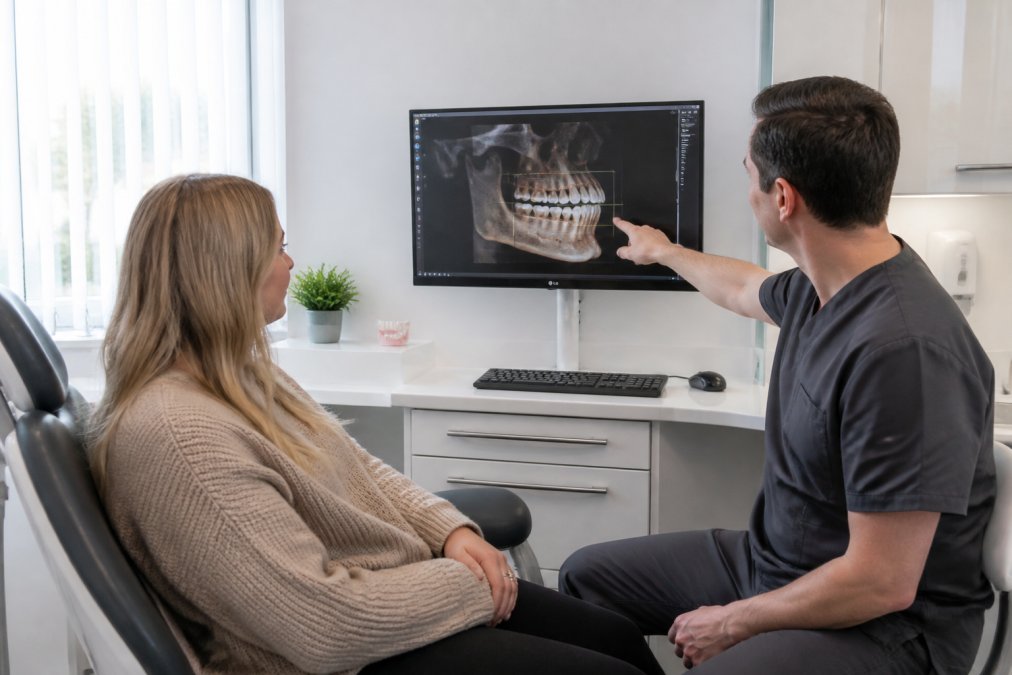
The first appointment is a comprehensive assessment. We examine your teeth and gums, take X-rays, and use a 3D CBCT scan to map bone depth, width, and nerve positions.
This scan matters more than a standard X-ray. It shows whether the jawbone can support an implant post without touching nerves or sinuses.
We also review your medical history, medications, and any habits that slow healing. Nervous patients can discuss their concerns here, since the consultation sets the tone for everything that follows.
You should leave this appointment knowing:
- Whether implants suit your case
- What preparation you need, if any
- A rough timeline from surgery to final tooth
Step 2: Bone Grafting and Sinus Lift If Needed
Some patients need extra bone before an implant can be placed. Bone grafting adds material to a thin or damaged jaw so the post has something solid to anchor into.
A sinus lift is a related procedure for upper back teeth. It raises the sinus floor to create room for the implant.
Both are common and planned in advance. Skipping them usually leads to a loose implant later, which is far harder to fix than the graft itself.
NHS information on dental treatments and procedures
Step 3: Placing the Titanium Implant Post
Surgery is the step most patients ask about first, so it is worth walking through in detail. The aim is a calm, controlled appointment with no surprises.
Anaesthesia and sedation options
Most single implants are placed under local anaesthesia, the same type used for a filling. The gum and bone around the site are numbed, so you feel pressure and vibration rather than pain. The injection itself can be uncomfortable, and a topical gel may be applied first to dull it.
If you are anxious, or the treatment is longer, sedation can be added:
- Inhalation sedation (nitrous oxide and oxygen), you stay fully conscious but relaxed, and you can drive yourself home afterwards in most cases.
- Intravenous (IV) sedation, a stronger, drowsier calm. You will typically need a responsible adult to escort you home and stay with you for the rest of the day.
- General anaesthesia, reserved for complex cases, multiple implants, or patients who cannot tolerate treatment awake. This is carried out in a hospital or specialist setting.
Discuss which option suits you at the consultation, not on the day. It changes your aftercare instructions, including whether you can drive or return to work.
What happens during the appointment
The surgeon makes a small incision in the gum, lifts a flap to expose the bone, and prepares the site with a sequence of drills of increasing width. The titanium post is then threaded into place.
Titanium is used because it is biocompatible: bone accepts it rather than rejecting it. Some cases use zirconia posts instead, usually for patients with a metal sensitivity or a preference for a metal-free restoration.
The surgical site is closed with sutures, and most single-implant appointments take under an hour. You go home the same day, usually within an hour or two of arriving.
Pain relief: plan it before, not after
Take simple pain relief such as paracetamol or ibuprofen as directed before the anaesthetic wears off, rather than waiting for discomfort to build.
Ask about pain relief before surgery day, not after. Knowing exactly what to expect at home removes most of the fear around this step.
Step 4: Osseointegration and Dental Implant Recovery Time
Osseointegration is the process where bone grows around the implant post and locks it in place. This is why implants feel like real teeth rather than sitting on top of the gum. It is also the step that cannot be rushed, the bone needs uninterrupted time to bond to the titanium surface.
What the first two weeks actually look like
- Days 1-2: Some bleeding at the site is normal, along with swelling and a dull ache. Use a cold compress in short bursts, rest, and keep your head elevated when lying down.
- Days 3-5: Swelling usually peaks and then starts to ease. Switch to a soft diet, yoghurt, soup, mashed vegetables, scrambled eggs. Avoid very hot drinks and crunchy foods.
- Days 6-14: Discomfort fades. Gentle rinsing with a saltwater solution or a prescribed mouthwash helps keep the site clean. Sutures are usually removed at a review appointment, or dissolve on their own.
What the months after look like
During healing:
- Eat soft foods for the first week, then reintroduce firmer foods gradually
- Avoid smoking, which slows bone healing and raises the risk of failure
- Keep the site clean as directed, and do not poke at it
- Attend every review appointment, even if everything feels fine
Normal healing versus something wrong
- Pain that is getting worse rather than better after the first few days
- A fever, or a feeling of being generally unwell
- Pus, a persistent bad taste, or discharge from the site
- A post that feels loose, or a crown that moves
- Numbness in the lip, chin, or tongue that does not fade
How long the whole phase takes
Smoking is the single biggest controllable factor in whether an implant integrates. Even cutting down in the weeks around surgery improves the odds.
Step 5: Fitting the Abutment and Final Crown
Once the implant is stable, we fit the abutment, a small connector that sits between the post and the tooth. Then we take a dental impression for the dental crown.
The Cost of Dental Implants UK Patients Should Budget For
The cost of dental implants UK patients pay varies widely. It depends on how many implants you need, whether grafting is required, and the type of final restoration.
Budget for these separate elements:
- The 3D CBCT scan and assessment
- Bone grafting or sinus lift, if needed
- The implant post and surgery
- The abutment
- The final crown, bridge, or denture
Dental Implant Aftercare Advice for Long-Term Success
Dental implant aftercare advice comes down to three habits: clean daily, attend reviews, and act fast when something changes. Implants do not decay, but the gum and bone around them still can.
Warning Signs of Implant Failure and Peri-Implantitis
Watch for these signs and contact us if they appear:
- Gum bleeding or swelling around the implant
- A loose or wobbly crown
- Pain when biting
- Receding gums exposing the post
- Persistent bad taste or discharge
Ignoring bleeding gums around an implant is a common mistake. Peri-implantitis rarely hurts at first, so patients may delay seeking treatment, and by then bone loss may have already started.
Frequently Asked Questions
How long does the dental implant process take from start to finish?
Most dental implant process timelines run from three to nine months. The implant post is placed first, then left to fuse with the jawbone for roughly three to six months. If a bone graft is required, add several months before placement. The abutment and final crown follow once healing is complete. Your own timeline depends on bone quality and healing speed, so your dentist will give you a personalised schedule at consultation.
Is the dental implant procedure painful?
The procedure itself is carried out under local anesthesia, so you should not feel pain while the implant post is placed. Most patients describe the days afterwards as mild soreness rather than sharp pain, managed with ordinary pain relief. Swelling and tenderness usually settle within a week. If you are nervous, tell your dental team, as sedation options can make the appointment more comfortable.
Do I need a bone graft before getting dental implants?
Not everyone does. A bone graft is only needed when the jawbone is too thin or soft to hold the implant securely. This often happens after a tooth has been missing for a while. Your dentist will confirm whether grafting is required using a 3D CBCT scan during your initial assessment. If it is needed, the graft is usually placed a few months before the implant post.
Are dental implants available on the NHS?
Dental implants are not routinely available on the NHS for cosmetic tooth replacement. They may be funded in specific circumstances, such as certain medical conditions or trauma, and only when a clinical need is agreed. Availability varies by health board. For most patients, implants are a private treatment. Ask your dentist about your eligibility and check the current official guidance before assuming cover.
Missing teeth rarely stay a small problem. Bone shrinks, nearby teeth shift, and eating becomes a chore. At Orangefield Dental Care, we plan the full dental implant process around your comfort, with pain-free dentistry, evening appointments, and emergency care when something goes wrong. Book an appointment and get a clear plan, a written cost breakdown, and honest advice on whether implants are right for you.