
Table of Contents
- Is Dental Sedation Safe for Adults? What the Evidence Says
- Understanding Conscious Sedation for Dental Work
- How Dentists Assess Your Safety Before Sedation
- Dental Sedation Side Effects and How They’re Managed
- IV Sedation Recovery Time: What to Expect After Your Appointment
- Preparing Safely: Steps to Follow Before Your Sedation Appointment
- Final Verdict: Weighing the Risks and Benefits of Dental Sedation
- Frequently Asked Questions
Last Updated: September 6, 2026
Is Dental Sedation Safe for Adults? What the Evidence Says
For adults who avoid the dentist due to fear, the question of whether dental sedation is safe remains the biggest barrier to booking. For healthy adults assessed properly by a trained team, modern dental sedation carries a well-established safety record.
Dental sedation uses medication to help you relax during a procedure, and is distinct from general anaesthesia because you remain conscious and able to respond throughout. This guide explains how safety is assessed, what side effects to expect, and how to prepare.
Understanding Conscious Sedation for Dental Work
Conscious sedation for dental work is a drug-induced state where you stay awake and can breathe independently, but you feel deeply relaxed and have little memory of the treatment. The key distinction is that your protective reflexes remain intact, which is the primary reason it is considered safe for outpatient dental procedures.
The medication is tailored to your weight, medical history, and treatment complexity, and adjusted throughout by the clinical team. You will be drowsy but able to respond to gentle prompts, not unconscious.
Levels of Sedation: From Minimal to Deep Anaesthesia
Sedation exists on a spectrum, and knowing where your treatment sits helps you understand the associated risks.
- Minimal sedation: You are awake and relaxed, typically achieved with inhaled nitrous oxide, sometimes called laughing gas.
- Moderate sedation: You are drowsy and may slur words, but you respond to touch and speech. This is the usual target for dental phobia cases.
- Deep sedation: You are on the edge of consciousness and may not remember the procedure, though you still breathe on your own.
- General anaesthesia: You are fully unconscious and require airway support; this is reserved for complex surgery and hospital settings.
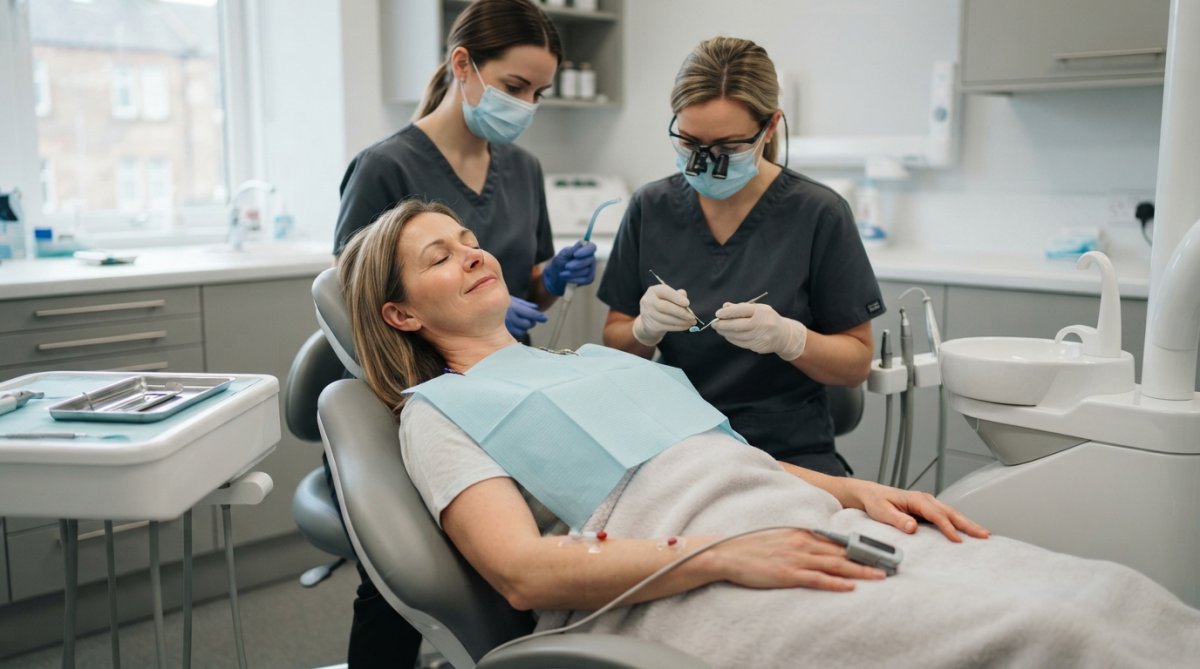
The depth of sedation determines the level of clinical monitoring required. For moderate conscious sedation, your blood pressure, heart rate, and oxygen saturation are tracked continuously.
How Dentists Assess Your Safety Before Sedation
Your safety is determined largely before you ever sit in the chair. A thorough pre-sedation assessment is the single most important step, and it is non-negotiable for any responsible practice.
The assessment begins with a detailed medical history covering heart conditions, respiratory disorders, and any previous reactions to sedative medications. You will also be asked about current prescriptions, over-the-counter remedies, and recreational drug use, as these can interact with the sedative agents.
Key Medical History Checks and Contraindications
Several factors can rule out sedation or require a specialist referral:
- Obesity or obstructive sleep apnoea can compromise breathing during deeper sedation.
- Significant cardiac or respiratory disease may require hospital-based treatment.
- Pregnancy typically rules out elective sedation.
- Certain medications, including strong opioids or sedatives, increase the risk of respiratory depression when combined with dental sedation agents.
Never withhold information about your health history to avoid disappointment. A missed contraindication can turn a routine sedation appointment into an emergency. Always disclose fully, even if you think the detail is minor.
The assessment also determines the sedation depth that is appropriate for you. Healthy adults under 65 with no significant medical conditions are generally suitable for moderate conscious sedation in a dental chair, whereas patients with complex needs may be referred to a specialist centre. This screening process is why dental sedation is considered safe for adults when delivered by trained professionals who follow established clinical protocols, such as those outlined by the General Dental Council’s standards for sedation.
Dental Sedation Side Effects and How They’re Managed
The most common dental sedation side effects are mild and short-lived. You may feel drowsy, experience a dry mouth, or have a mild headache for a few hours after the appointment. Some patients report nausea, though this is less common with modern agents.
More significant side effects, such as respiratory depression or an allergic reaction, are rare because the sedation depth is constantly monitored. Your oxygen saturation and heart rate are tracked throughout, and the team is trained to adjust the dose or intervene immediately if your vital signs change.
Ask your dentist which sedative agent they plan to use. Knowing whether you are receiving midazolam, nitrous oxide, or an alternative helps you understand the specific side effect profile and recovery pattern you should expect.
The management of side effects is proactive, not reactive. Emergency drugs and resuscitation equipment are always available in the treatment room, and every member of the clinical team is trained in emergency preparedness.
IV Sedation Recovery Time: What to Expect After Your Appointment
IV sedation recovery time is often quoted as ‘a few hours,’ but that understates the picture. The sedative effects, drowsiness, a floating sensation, short-term memory loss, typically fade within one to two hours after the infusion stops. However, the drug (usually midazolam) has a half-life of two to six hours, meaning your liver and kidneys take several more hours to clear it. This is why the official advice is not to drive, operate machinery, or make significant decisions for a full 24 hours.
Most patients feel ‘back to normal’ by the next morning, but the day after your appointment requires more planning than many realise. Here is a practical, hour-by-hour guide to the first 24 hours after moderate conscious sedation:
Hours 0-2 (in the clinic): You will be moved to a recovery area and monitored until your blood pressure, heart rate, and oxygen saturation return to your baseline. You will be offered a drink and something light to eat. You may feel chatty or emotional as the drug wears off, this is normal.
Hours 2-6 (at home): You will still be drowsy. Do not cook, use sharp tools, or care for young children unattended. Arrange for a responsible adult to stay with you. Your short-term memory may be patchy, so write down any post-operative instructions before you leave the clinic.
Hours 6-12 (evening): You can eat a normal meal if you feel up to it, but avoid alcohol entirely, it amplifies the sedative effect and slows recovery. Avoid making any important decisions or signing documents. Your reaction times are still impaired even if you feel alert.
Hours 12-24 (next morning): Most people feel fully recovered, but a minority report residual grogginess or a mild headache. If you have had a longer procedure or a higher dose, take the morning off work if possible. Do not drive until you are certain you are alert and your dentist has confirmed it is safe.
Plan your recovery logistics before the appointment, not after. The sedation itself is the easy part; the recovery window requires advance planning for transport, childcare, and work cover. A written checklist, who drives you, who stays with you, what you will eat, and whether you have the next day off, removes the last-minute scramble that adds stress to an already anxious day.
Patients often underestimate the ‘day-after’ effect: they feel fine at 8am, drive to work, then struggle with concentration by mid-afternoon. Treat the day after as a light day, no driving, heavy machinery, or important meetings.
Recovery is not just about the drug, it is about the procedure itself. If you have had multiple extractions or implant placement, your recovery will be shaped as much by the surgical site as by the sedation. Ask your dentist for a combined recovery plan covering both.
Preparing Safely: Steps to Follow Before Your Sedation Appointment
Preparation is a partnership between you and your dental team. Before focusing on fasting and transport, it is worth clarifying what sedation is not, and how it differs from the local anaesthetic you may have had before.
Sedation vs. local anaesthesia: two different safety profiles. Local anaesthetic (such as lidocaine) numbs the specific area; you remain fully alert and can drive yourself home. Sedation works on your central nervous system to reduce anxiety and memory of the procedure, carrying risks related to breathing and cardiovascular function. For many patients with mild anxiety, local anaesthetic plus a pre-appointment chat avoids recovery restrictions entirely.
The medical criteria that determine your safety. Your pre-sedation assessment is not a formality; it is a clinical screening process that follows national guidelines. Your dentist will record your weight, blood pressure, heart rate, and oxygen saturation. They will ask about:
- Cardiovascular conditions: uncontrolled hypertension, angina, or a history of heart attack may require a specialist setting.
- Respiratory conditions: asthma, COPD, or sleep apnoea affect how your body handles sedative drugs.
- Liver or kidney function: these organs clear the sedative from your body; impairment prolongs recovery.
- Current medications: especially opioids, benzodiazepines, antidepressants, and some blood pressure drugs, which can interact with midazolam.
- Pregnancy or breastfeeding: elective sedation is typically deferred.
Never withhold information about your health history to avoid disappointment. A missed contraindication can turn a routine sedation appointment into an emergency. Always disclose fully, even if you think the detail is minor. If you are unsure whether a condition matters, tell your dentist anyway, that is what the assessment is for.
The financial question most guides skip: is sedation a medical need or a comfort extra? In the UK, sedation for a clinically indicated procedure (such as a surgical extraction or root canal) is often considered part of the treatment pathway, and some insurance plans may contribute. Sedation purely for anxiety during a routine check-up is typically ‘comfort-only’ and rarely covered. Ask for a written treatment plan separating procedure and sedation costs.
Practical preparation steps. Once you and your dentist have agreed on the sedation type, the rules are straightforward:
- Fasting: You will usually be advised to avoid solid food for six hours before your appointment, though clear fluids may be allowed up to two hours beforehand. This reduces the risk of aspiration if complications arise. Follow the exact timing your clinic gives you.
- Transport: Arrange for a responsible adult to accompany you home and stay with you for several hours. You cannot drive, cycle, or use public transport alone for 24 hours.
- Medication: Take your regular prescription medications as usual unless your dentist or doctor advises otherwise. Bring a list of everything you take.
- Clothing: Wear loose, comfortable clothing with short sleeves, your blood pressure cuff and IV line need easy access.
- Psychological preparation: Tell your dentist about your specific fears, whether that is the sound of the drill or the sight of a needle. Many practices offer a pre-appointment chat so you can familiarise yourself with the environment and the team before the day itself. This simple step reduces anticipatory anxiety and means you need a lower dose of sedation, which in turn reduces side effects and speeds up your recovery.
Ask your dentist two questions at your assessment: ‘What is the minimum level of sedation that will work for my anxiety?’ and ‘If I chose local anaesthetic alone, what would change about my recovery?’ The answers may surprise you, many patients discover they do not need deep sedation at all, which simplifies both the safety profile and the cost.
Final Verdict: Weighing the Risks and Benefits of Dental Sedation
The evidence and clinical consensus point to the same conclusion: for appropriately selected healthy adults, the benefits of dental sedation far outweigh the risks. The alternative is often years of avoided dental care, leading to more invasive and costly treatment.
The risks that do exist are manageable because they are predictable. The screening process identifies potential problems before medication is given, and continuous clinical monitoring during the procedure means complications are caught early. This layered approach is why regulatory bodies consider sedation a safe option when delivered under strict protocols, as reflected in the Safe Sedation Practice guidance from the Care Quality Commission and related clinical standards.
Sedation is a spectrum of techniques, and the safest option is matched to your anxiety level, medical history, and treatment complexity.
If you are considering sedation, the first step is an honest conversation with your dental team. At Orangefield Dental Care, we focus on pain-free dentistry and supporting nervous patients through every stage of their treatment, with flexible evening appointments to fit around your schedule. We will assess your medical history thoroughly, explain your options clearly, and help you decide whether conscious sedation is right for you. For a fuller picture of how sedation fits into a complete care plan, resources from the British Dental Association on patient information offer useful background reading.
Deciding whether dental sedation is right for you comes down to feeling informed and supported, not just clinically assessed. The safest approach is one where your medical history is reviewed thoroughly, your anxieties are heard, and your recovery is planned in advance. Orangefield Dental Care combines comprehensive general and cosmetic dentistry with a commitment to patient comfort, offering emergency services and evening appointments when you need them most. Book an appointment to discuss your options with a team that treats nervous patients with genuine care.
Frequently Asked Questions
Will I be completely asleep during dental sedation?
Not necessarily. The level of sedation varies. With conscious sedation, you remain awake but deeply relaxed and drowsy. You can usually respond to verbal prompts and breathe on your own. Deeper levels of sedation can make you sleepier, but true general anaesthesia, where you are completely unconscious, is rarely used for routine dental work. Your dentist will discuss the appropriate level of sedation for your procedure and anxiety level during your consultation.
What is the typical IV sedation recovery time?
Most people feel the main effects of IV sedation wear off within one to two hours after the procedure. However, you may feel drowsy, and your coordination and judgement can be affected for the rest of the day. It is essential to arrange for a responsible adult to accompany you home and stay with you for 24 hours. You should avoid driving, operating machinery, and making important decisions until the next day.
How does a dentist decide if I’m a suitable candidate for sedation?
Your dentist will start with a thorough medical history assessment. They need to know about any existing health conditions, such as heart or lung disease, and all medications you take, including herbal supplements. This helps identify any contraindications. The dentist will also consider the type of dental work you need and your level of anxiety to determine the safest and most effective sedation method for you.
Are there common dental sedation side effects?
Yes, most side effects are mild and temporary. For oral sedation or nitrous oxide, you might feel drowsy, dizzy, or experience a dry mouth. With IV sedation, some patients feel slight bruising at the injection site or brief nausea. Headaches are also possible as the medication wears off. Serious complications are rare because your vital signs are monitored continuously throughout the procedure to ensure your safety.