
Table of Contents
- How Long Does Teeth Whitening Take? The Honest Timeline
- In-Surgery vs. At-Home Whitening: Time Compared
- How Many Shades Lighter Can You Expect?
- What to Expect During Your Whitening Appointment
- How Long Does Teeth Whitening Last and What Affects It
- Teeth Whitening Side Effects and Managing Sensitivity
- Why a GDC Registered Dentist Whitening Service Matters
- Whitening for Specific Stain Types: Extrinsic vs. Intrinsic
- Maintenance and Aftercare: Keeping Your Results
- Frequently Asked Questions
Last Updated: September 10, 2026
How Long Does Teeth Whitening Take? The Honest Timeline
Most people researching how long does teeth whitening take want one number. The honest answer depends on the route: an in-surgery session typically takes 60 to 90 minutes, while a custom at-home kit usually runs two to four weeks of daily or nightly wear. At Orangefield Dental Care, we talk patients through both before recommending one.
The treatment itself is rarely the slow bit. The assessment, shade matching and aftercare plan determine whether your results last months or fade within weeks. Below, we break down realistic timings for every stage.
In-Surgery vs. At-Home Whitening: Time Compared
In-surgery whitening delivers visible results in a single appointment; at-home whitening trades speed for a gentler, more gradual change. Neither is “better” in the abstract, they suit different situations.
In-surgery (chairside) whitening uses a professional-strength bleaching gel, often light-activated, applied under controlled conditions. You’ll typically see a noticeable shade improvement before you leave, though a top-up session may be recommended. At-home whitening uses custom-fitted trays and a lower-concentration gel, worn over a set period, slower, but easier to manage if your teeth are prone to sensitivity.
| Route | Typical Time to Visible Results | Number of Sessions | Best For |
|---|---|---|---|
| In-surgery (chairside) | Same day | 1, sometimes 2 | Events, fast results |
| Custom at-home trays | 2-4 weeks | Daily wear at home | Gradual, controlled change |
| Combination | 1 day plus 2 weeks | 1 visit plus home wear | Stubborn staining |
A common mistake is assuming at-home kits are simply “slower versions” of the same thing. In practice, gel concentration and tray fit differ enough that results vary widely.
How Many Shades Lighter Can You Expect?
There’s no guaranteed number of shades, and any provider promising a specific figure is overselling. Most people see a meaningful improvement, but the exact change depends on your starting shade, the type of staining and how your enamel responds.
Whitening efficacy comes down to three things: the concentration of the bleaching agent (hydrogen peroxide or carbamide peroxide), how long it stays in contact with the tooth, and whether stains sit on the surface or deeper inside. Extrinsic stains from coffee, tea and red wine respond well; intrinsic stains within the tooth structure are harder to shift and sometimes need a different approach.
Your dentist will use a shade guide before and after treatment so you can see the change objectively. That record tells you what’s realistic for a top-up later.
What to Expect During Your Whitening Appointment
An in-surgery appointment usually runs 60 to 90 minutes from walking in to walking out. Knowing the sequence in advance can help reduce anxiety.
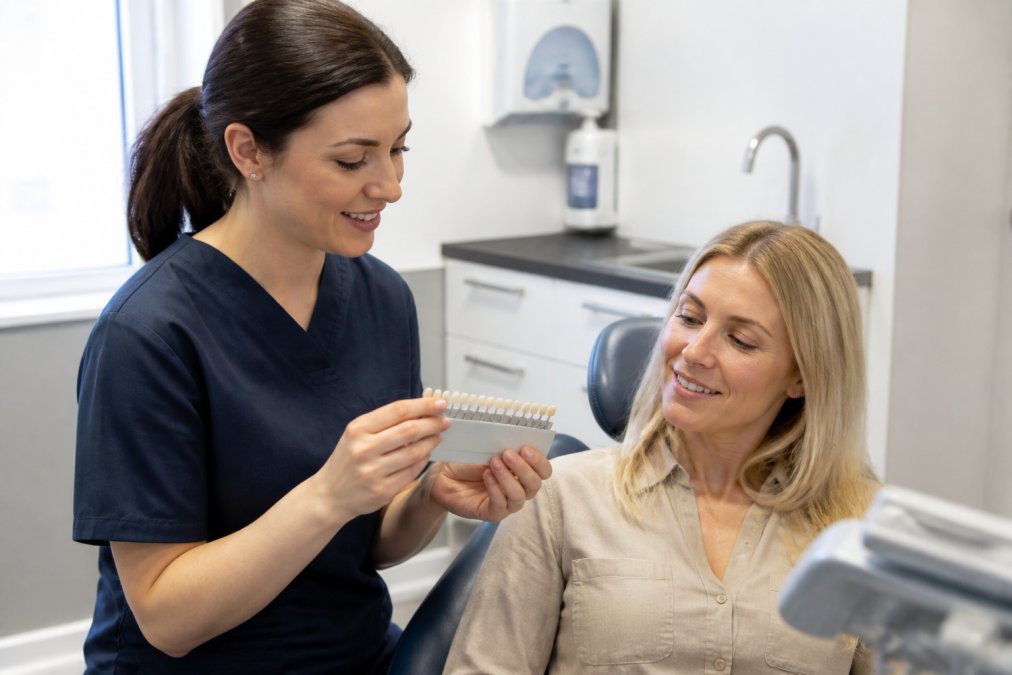
Stage 1: Assessment and Shade Recording (10-15 minutes)
Your dentist examines your teeth and gums first. This isn’t a formality: whitening isn’t suitable if you have untreated decay, gum disease, cracked enamel or exposed dentine, and going ahead regardless can cause pain or worsen existing problems. The assessment also identifies your stain type, which shapes the recommendation and gel strength used.
Your starting shade is then recorded against a shade guide under consistent lighting so the comparison is meaningful. Ask for a copy.
Stage 2: Isolation and Gum Protection (10-15 minutes)
Before any gel goes near your teeth, your dentist isolates them. A protective barrier, often a light-cured resin dam or liquid dam, is painted onto the gums and set. This matters: bleaching gel contacting gum tissue can cause irritation.
Retractors keep your lips and tongue clear of the working area. You’ll feel some pressure and dryness, but no pain.
Stage 3: Gel Application and Activation (20-45 minutes)
Professional-strength bleaching gel, typically hydrogen peroxide at a concentration only a registered professional can supply, is applied to the tooth surfaces. It may be light-activated or left to work on its own.
The gel is usually applied in cycles, commonly three of 10 to 15 minutes each, refreshed between cycles. That’s why the whitening itself is the bulk of the visit. You may feel tingling or warming during the first cycle; tell your dentist if it becomes sharp, as they can adjust the concentration or shorten the cycle.
Stage 4: Review, Rinse and Aftercare (10-15 minutes)
The gel is removed, the isolation taken down, and your teeth rinsed. Your dentist records your new shade against the same guide used at the start. You’ll leave with written aftercare instructions.
The At-Home Appointment, for Comparison
If you’ve chosen custom trays, the in-practice visit is much shorter, usually 20 to 30 minutes. It covers the same assessment and shade recording, then impressions are taken. Trays are typically ready within one to two weeks, and the whitening happens at home over the following two to four weeks.
Book your appointment for a day when you don’t need to be anywhere straight afterwards. Your teeth will be more sensitive to cold for a few hours, and you’ll want to avoid staining food and drink for the rest of the day.
How Long Does Teeth Whitening Last and What Affects It
Results commonly hold for several months to around two years, depending on your habits. Bleaching doesn’t stop your teeth from staining again, it resets them. What happens next is largely down to diet and oral hygiene.
Dietary Impact Timeline: What to Avoid and for How Long
For the first 48 hours after whitening, your teeth are more porous and absorb colour easily. During that window, avoid:
- Coffee, tea and red wine
- Dark sauces, curry and tomato-heavy dishes
- Berries and other strongly coloured fruit
- Fizzy drinks and fruit juice
- Smoking and vaping
After 48 hours, you can reintroduce these, but frequency matters. Regular coffee drinkers typically need touch-ups sooner than people who rarely drink it. A practical habit: use a straw for cold coloured drinks and rinse with water afterwards.
Age, Enamel Condition and Whitening Efficacy
Age changes how teeth respond to whitening, and it’s rarely discussed honestly. Enamel thins over time, exposing more of the yellower dentin beneath, so older teeth often need longer treatment or a combination approach to match what a younger patient gets quickly. Existing restorations, crowns, veneers, composite bonding, don’t whiten at all and may need replacing afterwards to match your new shade. Mention any restorations at your assessment.
Teeth Whitening Side Effects and Managing Sensitivity
Tooth sensitivity is the most common side effect, usually a short-lived tingling or sharp response to cold. It typically settles within a day or two, and is more likely with higher-concentration gels and longer wear times.
If you’re prone to sensitivity, tell your dentist before treatment starts. Options include a lower-concentration gel, shorter wear sessions, or a desensitising product applied before and after. Gingival irritation, where gel contacts the gums, is the other frequent complaint, almost always a tray-fit problem, which is why custom-fitted trays matter so much.
Never extend your wear time “to get better results”. Leaving bleaching gel on longer than instructed raises the risk of enamel damage and significant gum irritation, and it does not speed up the shade change.
Why a GDC Registered Dentist Whitening Service Matters
Teeth whitening is a regulated procedure. In the UK, only a dentist, dental therapist, dental hygienist or clinical dental technician registered with the General Dental Council may carry out whitening legally, and bleaching agents above certain concentrations must be supplied by a registered professional (gdc-uk.org). Beauty salons and online sellers offering stronger kits operate outside the law.
That regulation exists for a reason. A General Dental Council guide to teeth whitening sets out who can legally whiten teeth and what a safe service looks like. An unregulated provider can’t assess whether whitening is safe for you, can’t prescribe the appropriate gel strength, and won’t have your dental history. The Oral Health Foundation’s guidance on tooth whitening makes the same point from the patient’s side: a dental assessment comes first, not last.
At Orangefield Dental Care, whitening starts with a full assessment and a shade record.
Whitening for Specific Stain Types: Extrinsic vs. Intrinsic
Different stains need different plans, and this is where a generic kit falls short. Extrinsic stains sit on the tooth surface and come from food, drink and tobacco; they respond well to standard whitening. Intrinsic stains sit within the tooth and can result from trauma, certain medications, or fluorosis; these often need a longer course, a higher-concentration professional gel, or an alternative cosmetic treatment.
There’s a third category worth knowing: age-related staining, which is a mix of surface staining and the natural yellowing of dentin showing through thinner enamel. If you’re over 40 and whitening hasn’t worked as well as you hoped, this is often why.
Take a photo of your teeth in natural daylight before you start. Shade guides are precise, but a dated photo is the easiest way to judge your own progress over weeks when daily changes are too gradual to notice.
Maintenance and Aftercare: Keeping Your Results
Touch-ups protect your investment. For at-home users, most dentists suggest a short top-up every few months using the same custom trays. For in-surgery patients, a single top-up session when you notice fading keeps the shade steady rather than letting it drift back.
But the first 48 hours after whitening matter more than any other period. Here is a specific timeline to follow.
The First 48 Hours: A Dietary Timeline
For roughly 48 hours after whitening, your enamel is more porous than usual and absorbs colour readily. What you eat and drink in this window can undo a noticeable amount of the shade change.
Hours 0-6: Clear and white only. Water, milk, plain yoghurt, white fish, white rice, white pasta, bananas, and skinless chicken or turkey. Avoid anything with colour, including tea, coffee, cola, red wine, tomato sauce, curry, berries, beetroot, and dark chocolate. Avoid smoking and vaping entirely.
Hours 6-24: Keep it pale. Continue the white and neutral foods. Cold drinks are fine, but use a straw for anything that isn’t water, and rinse with water immediately after eating or drinking anything coloured.
Hours 24-48: Hold the line. You can reintroduce most foods, but keep strongly staining items, coffee, tea, red wine, curry, tomato-based sauces, and berries, off the menu for the full 48 hours if you can. If you must have coffee, drink it through a straw and rinse afterwards.
After 48 hours: Reintroduce foods gradually. Frequency matters more than the occasional treat. A daily coffee habit will fade your results faster than a weekly one.
Don’t use whitening toothpaste during the first 48 hours. It’s abrasive and can irritate already-sensitive enamel. Stick to a soft brush and a fluoride toothpaste.
Day-to-Day Maintenance That Actually Works
Once the initial window has passed, the routine below does most of the work:
- Brush twice daily with a fluoride toothpaste
- Floss or use interdental brushes daily
- Rinse with water after coffee, tea or wine
- Use a straw for cold coloured drinks where practical
- Attend routine dental check-ups
- Book a professional clean to lift surface stain
- Keep your custom trays clean and stored dry
- Avoid smoking, which fades results faster than any food or drink
When to Book a Top-Up
Patients commonly notice the first signs of fading around the three- to six-month mark, depending on diet and smoking. Rather than waiting until you’re back at your starting shade, book a short top-up when you first notice the change. For at-home users, that’s usually one or two nights with the custom trays; for in-surgery patients, a single shorter session.
If you’re a regular coffee drinker, a smoker, or eat a lot of curry or tomato-based food, expect to need top-ups more often. Whitening can’t outrun a daily staining habit.
Keep a dated photo of your teeth in natural daylight from the day of your treatment. It’s the easiest way to judge fading objectively, because gradual changes are almost impossible to notice in the mirror.
Frequently Asked Questions
Do teeth turn yellow again after whitening?
Teeth can gradually yellow again after whitening, but the rate depends on your diet and oral hygiene. Coffee, tea, red wine and smoking speed up restaining. Most people see results last from a few months to a couple of years. Touch-up treatments, either with custom trays or a quick in-surgery session, help maintain the shade. Avoiding staining foods for the first 48 hours after treatment makes a noticeable difference.
Is it worth getting teeth whitening at the dentist?
Professional whitening at a dental practice involves a dentist checking your enamel, gum health and any fillings or crowns first. Custom-fitted trays also mean the bleaching gel stays on your teeth rather than your gums. For anyone with existing dental work or sensitive teeth, a clinical appointment allows for professional oversight.
Are there legal restrictions on who can perform teeth whitening?
Yes. In the UK, teeth whitening is considered a dental procedure and must be carried out by a registered dental professional, such as a dentist, dental hygienist or dental therapist working under a dentist’s prescription. Beauticians and unregistered practitioners cannot legally perform it. Checking that your provider is GDC registered protects you from unsafe practices and ensures proper assessment before treatment.
How long does a typical teeth whitening appointment take?
An in-surgery whitening session usually takes between 60 and 90 minutes, including the dental assessment, shade guide check and the whitening itself. At-home whitening requires a shorter fitting appointment, often 30 to 45 minutes, where custom-fitted trays are made. Follow-up wear time at home varies by product, but many people wear trays for 30 to 60 minutes a day over one to two weeks.