
Table of Contents
- Why Evening Dental Checkups Suit Working Professionals
- What Is Conscious Sedation for Dental Work?
- Private Dental Checkup Cost UK: What to Expect
- Booking an Out-of-Hours or After-Work Appointment
- Fitting Oral Hygiene and Preventative Care Into a Busy Schedule
- Handling Dental Emergencies and Same-Day Services
- Frequently Asked Questions
Last Updated: September 24, 2026
Why Evening Dental Checkups Suit Working Professionals
Evening dental checkups are appointments scheduled outside standard working hours, typically after 5pm, so patients can attend without taking time off work. For professionals juggling meetings, commutes and deadlines, that flexibility removes the single biggest reason routine dental visits get postponed.
The problem is rarely motivation. Most people know they should book a checkup; they simply cannot justify losing half a day for it. Evening slots solve that logistics problem directly, and they make it easier to keep up with preventative care rather than waiting for a problem to force your hand.
An after-work appointment flips that sequence. You attend on your terms, and small issues stay small.
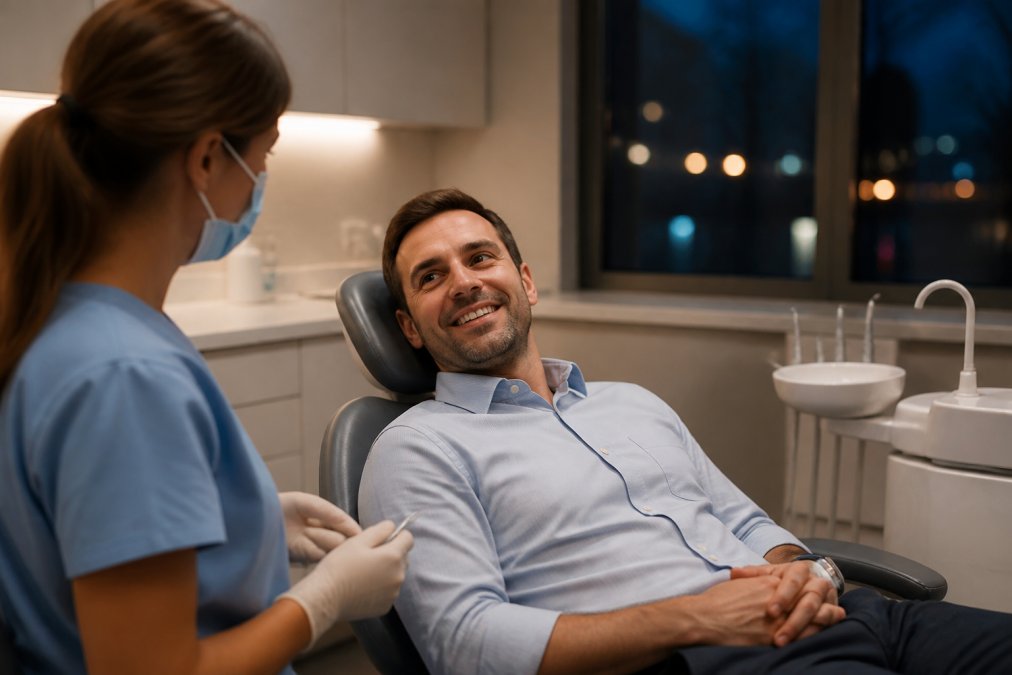
The main benefit of an evening slot is not convenience for its own sake. It is that you actually attend, which is what keeps preventative dentistry working.
What Is Conscious Sedation for Dental Work?
Conscious sedation is a technique where medication is used to relax you during dental treatment while you remain awake and able to respond to your dentist. It is commonly chosen by patients who feel anxious about needles, drilling or the general environment of a dental surgery.
Different levels of sedation exist, and the right option depends on your health, your anxiety and the treatment planned. Your dental team will assess this during a consultation and explain what to expect.
For nervous patients, sedation changes the calculation entirely. Instead of enduring an appointment, you drift through it. What most guides miss is that sedation is not only for major work; it can make a straightforward scale and polish manageable for someone who has avoided the dentist for years.
If anxiety has kept you away, say so when you book. A practice that offers pain-free dentistry will plan around it rather than rushing you.
Private Dental Checkup Cost UK: What to Expect
There is no single national price for a private dental checkup. Fees vary by practice, by region and by how much diagnostic work is included, so any figure quoted online should be treated as a guide rather than a rule. What matters more than the headline number is knowing what you are actually buying.
What the fee covers
A private checkup is a clinical assessment: an examination of your teeth and gums, a check for signs of dental decay or gum disease, and often diagnostic imaging such as X-rays where clinically needed. More complex assessments, or appointments that include a professional teeth cleaning, sit at a different fee level again. Some practices bundle a scale and polish into the checkup; others charge separately. Ask which model the practice uses before you book, because the two produce very different totals.
How to compare fees fairly
A cheap checkup that excludes X-rays or a gum assessment is not comparable to one that includes them. When you compare practices, compare the whole package:
- What is included in the examination fee?
- Are X-rays, photographs or gum measurements charged separately?
- Is a scale and polish included or added on?
- What is the fee for a follow-up treatment plan appointment?
- Is there a membership plan, and what does it cover across the year?
Many practices offer a monthly membership plan that spreads the cost of routine examinations, hygiene visits and a discount on treatment.
Workplace dental benefits and tax treatment
Dental cover is a common employee benefit, either as a standalone scheme or as part of a wider health cash plan. If your employer offers one, check what it covers: routine examinations, hygiene treatment, emergency care and a percentage of restorative work are typical inclusions. Some schemes pay a fixed amount per treatment; others reimburse a proportion of the cost up to an annual limit.
If you are self-employed or run your own company, dental treatment that is wholly and exclusively for the purposes of your business may be treated differently from routine personal care. The general position is that ordinary dental checkups are a personal expense, but where treatment is required because of a work-related injury or a specific business need, the tax treatment can change. Because the rules depend on your circumstances, take advice from an accountant rather than assuming either way.
Employers considering adding dental cover to a workplace wellness programme should also look at the tax position for the benefit itself. Some health-related benefits are taxable as a benefit in kind, while others fall within exemptions depending on how the scheme is structured. An accountant or benefits adviser can confirm how a proposed scheme would be treated.
Getting a clear answer on cost
Rather than guess, ask for a written treatment plan and fee breakdown before you commit to anything. That is standard practice and any reputable clinic will provide it.
Basing your decision on a headline price from an unrelated practice is a common mistake. Fees reflect what is actually included, and a cheap checkup that excludes X-rays or a gum assessment may not be comparable. The same applies to dental plans: a scheme that pays a fixed amount per visit may leave a larger balance than one that reimburses a percentage.
HMRC guidance on tax treatment of employer-provided health benefits
Booking an Out-of-Hours or After-Work Appointment
Before you book
- Check the practice’s opening hours first. Not every clinic runs late sessions on every day of the week, and some run them only on one or two evenings.
- Book online or by phone, and state your preferred time window. If you finish work at 6pm, say so, and ask whether the practice can hold a slot if you are running late.
- Ask how far ahead evening slots are booked. This is the single most useful question for a professional with a packed diary. If late slots go two to three weeks out, book the next one while you are on the phone rather than waiting for a gap in your calendar.
- Flag any anxiety or sedation interest at the point of booking. It affects how the appointment is scheduled and how long it needs to be.
- Confirm what happens if you need follow-up treatment. Some practices can plan this at the same visit; others will need a second appointment.
Pre-appointment preparation for a short evening slot
- Complete registration and medical history forms in advance. Most practices send these digitally when you book. Filling them in on the train beats filling them in at reception.
- Bring a current medication list, including anything prescribed, over-the-counter or herbal. Certain medicines and conditions affect what treatment is safe to carry out.
- Have your dental benefit details to hand. If you are covered through work or a dental plan, bring the policy or scheme name and membership number so the practice can check what is included before you are seen.
- Write down your symptoms and questions. Note when a sensitivity started, which tooth it affects, whether it wakes you at night, and anything you want to ask about whitening, aligners or a long-standing concern. A short list keeps the appointment focused.
- Bring your previous dentist’s details if you are new to the practice, so records can be requested.
- Arrive ten minutes early the first time. Parking, finding the entrance and settling in all take longer than you think in an unfamiliar building.
Questions worth asking before you book
- Do you offer after-work appointments on the day I need?
- How far ahead are evening slots usually booked?
- What is included in the checkup fee, and is imaging charged separately?
- Can you accommodate a family booking in one visit?
- If treatment is needed, can it be scheduled for another evening slot?
If you have a dental scheme, ask the practice whether they accept it before you book. Checking cover in advance avoids a conversation about payment at the end of a short evening appointment.
NHS guidance on finding an NHS dentist and what to do if you cannot access one
Fitting Oral Hygiene and Preventative Care Into a Busy Schedule
A consistent oral hygiene routine does not need to be elaborate. What it needs is to be realistic enough that you actually keep it up.
- Brush for two minutes, twice a day, with a fluoride toothpaste.
- Clean between your teeth daily, using interdental brushes or floss.
- Limit sugary snacks and drinks to mealtimes rather than grazing through the day.
- Keep water handy during long meetings; a dry mouth does your periodontal health no favours.
- Book routine examinations at intervals your dentist recommends for you.
Handling Dental Emergencies and Same-Day Services
Describe your symptoms clearly when you call: which tooth, how long the pain has lasted, whether it wakes you at night, and whether there is swelling. It helps the team assess urgency accurately and book you into the right slot.
For anyone with a history of dental anxiety, an emergency is the worst possible reintroduction to the chair. Mention your anxiety when you call. A practice set up for nervous patients can adjust the appointment accordingly rather than adding to the stress.
Frequently Asked Questions
Are evening dental appointments more expensive than daytime ones?
Not necessarily. Some practices charge the same rate for evening slots as daytime ones, while others add a small premium for out-of-hours cover. Pricing depends on the practice and the treatment. Ask about evening rates when you book so there are no surprises.
How can I fit regular dental checkups into a busy work schedule?
Book your appointment weeks in advance and choose a late slot, such as 6pm or 7pm, so it sits outside core working hours. Set a reminder for your recall date and combine the trip with your commute home to save time.
What is conscious sedation for dental work and is it right for me?
Conscious sedation uses medication to help you relax during treatment while you stay awake and able to respond. It suits nervous patients or those having longer procedures. It is not the same as a general anaesthetic. Suitability depends on your health and the treatment planned, so discuss it with a dentist at a consultation.
How often should professionals have a dental checkup?
Most adults are advised to have a checkup at intervals a dentist recommends based on their oral health, which for many people is every six to twelve months. If you have gum disease or a higher risk of dental decay, your dentist may suggest more frequent visits. Your recall interval is set after a clinical assessment.