
Table of Contents
- What to Expect: The Evening Dental Checkup Appointment Duration
- Routine Dental Checkup Duration: How Long Does a Standard Visit Take?
- What Happens During a Dental Checkup: Step-by-Step Breakdown
- Factors That Influence Your Appointment Length
- Evening and Weekend Availability: Booking Out-of-Hours Slots
- Routine Check-up vs. Emergency Treatment: How Duration Differs
- Cost Implications of Evening Slots and Private vs. NHS Access
- Conclusion
- Frequently Asked Questions
Last Updated: September 15, 2026
What to Expect: The Evening Dental Checkup Appointment Duration
A standard evening dental checkup appointment duration runs between 15 and 30 minutes for a routine examination, though a first visit or a check-up with X-rays can take closer to 40 minutes (the NHS). At Orangefield Dental Care, we offer flexible opening times including evenings.
Most people booking after work want one thing: to know how long they will be in the chair. The honest answer is that it depends on your oral health, your patient history, and whether the dentist needs diagnostic tools such as X-rays or a periodontal assessment.
Below, we break down what shapes that timing, what actually happens during a dental health assessment, and how to secure an out-of-hours slot when you need one.
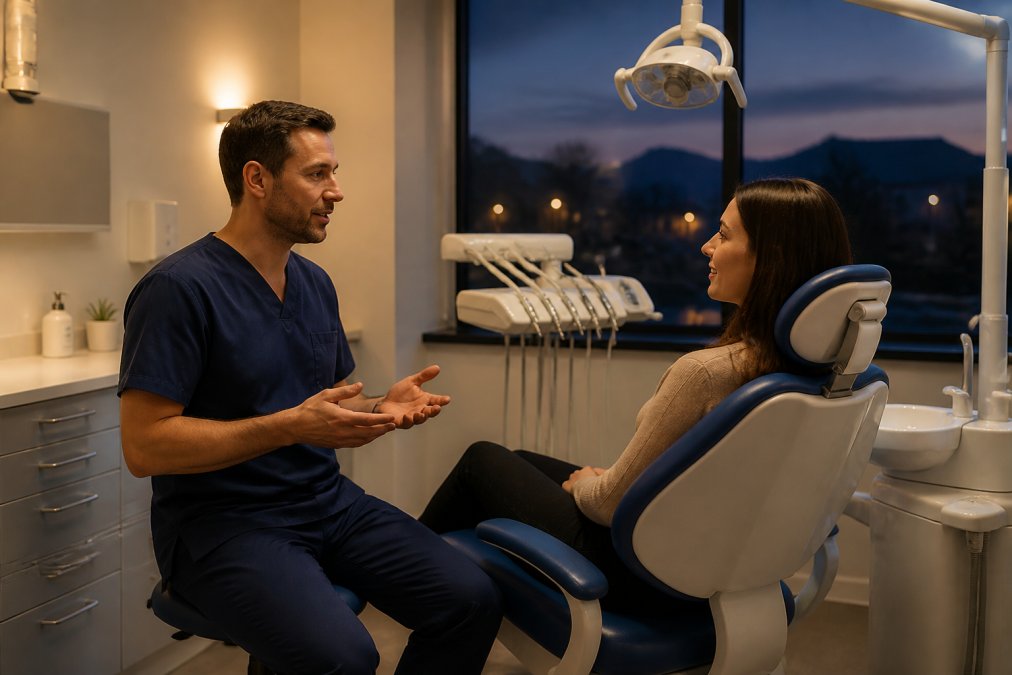
Routine Dental Checkup Duration: How Long Does a Standard Visit Take?
The average routine dental checkup duration is 15 to 20 minutes for an adult with no outstanding problems (NICE). A child’s check-up is often quicker, while a patient returning after several years away typically needs longer.
Several factors push a routine examination past the 20-minute mark:
- New patient registration. A first appointment includes a full patient history and a baseline oral examination, which adds time.
- X-rays or intraoral scans. These are not needed at every visit, but when they are, expect an extra 5 to 10 minutes.
- Periodontal health checks. If you have a history of gum problems, the dentist may carry out a fuller gum assessment.
- Scale and polish. Many check-ups include a dental hygiene clean, which can add 10 minutes or more.
A common mistake is assuming a check-up is a fixed-length product. It is not. The dentist adjusts the appointment duration to what your mouth actually needs that day.
What Happens During a Dental Checkup: Step-by-Step Breakdown
A dental checkup is a structured clinical assessment, not a quick glance at your teeth. Here is the typical sequence, and roughly how long each stage takes.
- Patient history review (2-3 minutes). The dentist asks about changes since your last visit, any pain, and relevant medical conditions or medication.
- Extraoral and soft tissue check (2 minutes). Lymph nodes, jaw joint, and soft tissues are examined for anything unusual.
- Oral examination (5-8 minutes). Each tooth is checked for decay, wear, and cracks, and existing fillings are assessed.
- Periodontal health assessment (2-5 minutes). Gum pockets may be measured with a probe if there are signs of gum disease.
- Diagnostic tools (variable). X-rays or photographs are taken only where clinically justified (General Dental Council).
- Treatment plan discussion (2-3 minutes). The dentist explains findings and outlines options and next steps.
- Scale and polish (optional, 10-15 minutes). Often booked as a separate hygiene appointment.
Expected result: you leave knowing your current dental health, what needs watching, and what, if anything, needs treatment.
If you are a nervous patient, tell the reception team when you book. A short note on your file lets the dentist build in extra time for explanation and to agree a stop signal before treatment begins, which is far easier to arrange in advance than mid-appointment.
Factors That Influence Your Appointment Length
Appointment duration is driven by clinical need, not by the clock on the wall. The biggest variable is your patient risk assessment: patients at higher risk of decay or gum disease are seen more often and often need longer visits.
Other factors that extend a check-up include:
- Complex dental history. Multiple crowns, implants, or ongoing treatment plans take longer to review.
- New or worsening symptoms. Pain or sensitivity requires investigation beyond a standard oral examination.
- Children and family bookings. A family of four booked back-to-back takes longer overall than four separate short visits, even though each individual check-up is brief.
- Follow-up requirements. If treatment is needed, a follow-up appointment is arranged, and that visit will have its own duration.
The thing nobody tells you about check-up timing is that the dentist often knows within the first two minutes whether this will be a short visit or a long one. The rest of the appointment is confirmation.
Evening and Weekend Availability: Booking Out-of-Hours Slots
Evening and weekend appointments exist precisely for people who cannot take time off during standard operating hours. Availability varies by practice, so the practical step is to ask directly what extended opening hours are offered and how far ahead evening booking slots fill up.
The gap most guides leave open is not whether evening slots exist, but how to secure one that gives you a full check-up rather than a rushed triage. The questions you ask at the point of booking determine which of those two you get.
Questions to ask when booking an evening slot
When you call, do not simply ask for “the next available appointment.” Ask these instead:
- “Is this a full check-up or a consultation?” Evening slots are sometimes allocated as short consultations. A full check-up includes the structured assessment described above; a consultation may only address one specific concern.
- “How long is the slot you are offering me?” Ask for the actual allocated time, not the practice’s general opening hours. A 15-minute evening slot cannot cover a new patient examination plus X-rays.
- “Will X-rays be taken in this appointment if needed, or booked separately?” Some practices split imaging into a follow-up visit, which changes your total time commitment.
- “Is a scale and polish included, or is that a separate hygiene appointment?” This is the single biggest variable in total visit length.
- “If I need treatment, will that be done in this slot or booked later?” Knowing this in advance prevents the surprise of a second evening visit.
- “Am I on the cancellation list if nothing suitable is free?” Evening slots are limited and go first, particularly Monday to Thursday.
How to book an out-of-hours appointment
- Call the practice and state your preference. Ask specifically for an evening or weekend slot rather than a general appointment.
- Book as far ahead as you can. Evening slots are limited and go first, particularly Monday to Thursday.
- Ask about the cancellation list. If no suitable slot exists, ask to be contacted when one frees up.
- Confirm the time you need to arrive. Evening appointments often run to a tighter schedule, so arriving early avoids losing your slot.
- Confirm the slot length in writing where possible. A text or email confirmation that states the appointment duration protects you if the practice later tries to shorten it.
For urgent problems outside opening hours, practices typically direct callers to an out-of-hours service. A telephone assessment or triage may be the first step, with a face-to-face appointment arranged if needed. The key distinction is that out-of-hours triage is designed to manage immediate risk, not to deliver a routine check-up.
If you are booking an evening slot for a child or as part of a family booking, ask whether the practice can schedule consecutive slots. Back-to-back family appointments are often more efficient than separate visits, but they need to be requested at the time of booking.
Do not assume an evening slot is available the same day. Turning up without an appointment, or calling at 8pm expecting to be seen immediately, usually ends in a waiting list rather than treatment. Plan ahead for routine visits and keep the emergency route for genuine urgency.
Routine Check-up vs. Emergency Treatment: How Duration Differs
An emergency dental appointment is longer and less predictable than a routine examination. Where a check-up follows a set sequence, emergency care starts with triage: working out what is causing the pain and how quickly it needs treating.
Typical differences:
| Appointment type | Typical duration | What happens | Booking route |
|---|---|---|---|
| Routine examination | 15-30 minutes | Full oral examination, risk assessment, treatment plan | Booked in advance |
| Check-up with X-rays | 30-40 minutes | Examination plus diagnostic imaging | Booked in advance |
| Emergency appointment | 30-45 minutes | Triage, pain relief, temporary or definitive treatment | Same-day where possible |
| Out-of-hours emergency | Variable | Telephone assessment first, then face-to-face if needed | Via out-of-hours service |
The key distinction is that emergency dental care focuses on the immediate problem, while a routine visit looks at the whole mouth and your longer-term preventative care.
Cost Implications of Evening Slots and Private vs. NHS Access
Check-up vs consultation: why the label matters for cost
Private vs NHS access
Evening slots are not automatically more expensive, but they are not automatically the same price either. The only way to know is to ask whether the slot is charged at the standard rate, whether it is NHS or private, and what is included in the fee.
Conclusion
Frequently Asked Questions
How long does an evening dental checkup appointment typically take?
An evening dental checkup usually lasts between 15 and 30 minutes, similar to a daytime appointment. The exact duration depends on whether you need X‑rays, a scale and polish, or a more detailed examination. If it is your first visit or you have complex needs, it may take closer to 45 minutes. For a precise estimate, contact the practice when booking.
What is included in a routine dental health check?
A routine dental health check includes a thorough examination of your teeth, gums, and mouth. The dentist will check for decay, assess gum health, screen for oral cancer, and may take X‑rays if needed. They will also discuss your oral hygiene and any concerns. The appointment typically ends with a treatment plan or advice on preventative care.
Does an evening dental appointment take longer than a daytime one?
No, the duration is generally the same. Evening appointments are simply scheduled outside standard working hours for your convenience. The length depends on the complexity of your checkup, not the time of day. Some practices may allocate slightly longer slots in the evening to accommodate patients who need extra time, but this varies.
How often should I book a dental checkup?
Most people should have a dental checkup every six months to a year, but your dentist will recommend a frequency based on your oral health. If you have gum disease or other risk factors, you may need more frequent visits. Evening slots can help you maintain regular checkups without disrupting your work schedule.