
Table of Contents
- Can You Drive After Dental Sedation? The Short Answer
- Driving After IV Sedation: What to Expect
- Driving After Inhalation Sedation: A Different Picture
- How Long Does Dental Sedation Last?
- Dental Sedation Escort Requirements: Getting Home Safely
- Driving the Day After Sedation: Is It Safe?
- Legal and Insurance Implications of Driving After Sedation
- What to Do If Sedation Effects Persist
- Frequently Asked Questions
Last Updated: October 18, 2026
Can You Drive After Dental Sedation? The Short Answer
So, can you drive after dental sedation in the UK? No, not if you have had intravenous or oral sedation. You must not drive for 24 hours after IV or oral sedation, and you will need a responsible adult to take you home. Inhalation sedation is different, but you still should not drive yourself until your dentist confirms you are fully recovered. (Source: guidance from the Department for Transport)
At Orangefield Dental Care, we tell every sedated patient the same thing: plan your journey before you book. Sedation slows your reflexes, muddles your judgement and affects your memory, and those effects can last long after you feel normal.
The rules are stricter than many people expect. Here is what actually applies, by sedation type.
Why Sedation Affects Driving Ability
Sedation is not the same as sleep. Conscious sedation keeps you awake but relaxed, and it changes how your brain processes information.
The effects that matter for driving are:
- Slower reaction time
- Poor coordination
- Blurred judgement
- Short-term memory gaps
- Reduced alertness
You may feel fine while still being impaired. That gap between feeling normal and being safe is where most problems happen.
Driving After IV Sedation: What to Expect
Driving after IV sedation is not allowed on the day of treatment, full stop. Intravenous sedation puts the sedative directly into your bloodstream, so the effects come on fast and wear off slowly.
The standard advice is to avoid driving for 24 hours. Some clinics advise longer, depending on the dose and how you responded.
Plan for these restrictions on treatment day:
- No driving a car, van or motorcycle
- No riding a bicycle
- No operating machinery
- No work that needs sharp focus
- No alcohol
You will also need someone to stay with you for the rest of the day. Ask them to note any instructions your dentist gives you, because you may not remember them yourself.
Driving After Inhalation Sedation: A Different Picture
Inhalation sedation with nitrous oxide (often called ‘gas and air’) is the outlier among sedation options. Because the gas is breathed in and out rather than metabolised through the liver, its effects clear quickly once the mask comes off, typically within a few minutes, though some people feel light-headed for up to an hour.
That faster recovery is why many clinics allow patients to drive themselves home after inhalation sedation, but only after a dentist has assessed them. The key point competitors often gloss over: ‘the gas has worn off’ and ‘you are fit to drive’ are two different judgements. Your dentist will check your coordination, alertness and orientation before you leave the chair.
What actually determines fitness to drive after nitrous oxide:
- Duration and dose: a short procedure at a low flow rate clears faster than a long session at a higher concentration.
- Your response: some people feel groggy for the rest of the morning; others are sharp within ten minutes.
- Other medications: if you have taken oral sedation as well, the 24-hour rule applies regardless of the gas.
- Procedure factors: lengthy treatment, blood loss or a stressful appointment can leave you tired even without lingering drug effects.
A practical rule that most practitioners find works well: do not drive until you have been fully alert for at least an hour after the mask is removed, and only if your dentist has explicitly confirmed you are fit. If you feel any residual light-headedness, blurred vision or unsteadiness, arrange a lift, even if you arrived by car.
Never drive based on how you feel alone. Nitrous oxide can leave reaction time and judgement impaired even when you feel alert. If in doubt, do not get behind the wheel.
If you are unsure, ask your dentist directly before treatment whether they expect you to be fit to drive afterwards. Clinics that offer inhalation sedation will usually tell you at the booking stage whether you should plan a lift as a backup.
How Long Does Dental Sedation Last?
How long dental sedation lasts depends on the type, the dose and your own body. There is no single answer that fits everyone.
Roughly speaking:
- Inhalation sedation: effects fade within minutes to an hour after the gas stops
- Oral sedation: effects can last several hours, and the 24-hour driving restriction still applies
- IV sedation: effects can linger through the day, with a 24-hour no-driving rule
Feeling alert is not proof you are clear-headed. Sedatives can leave you with slower reactions and poorer judgement after the drowsiness passes.
Medication-Specific Guidance and Individual Variation
Different sedatives behave differently. Some are short-acting, some build up in the body, and some interact with other medicines you take.
Your age, weight, health and other prescriptions all change how you respond. So does whether you are a regular caffeine drinker, how well you slept, and whether you ate beforehand. (Source: the effects of anaesthetic drugs on cognitive function)
That is why we never give a blanket “you’ll be fine by 3pm” answer. We assess you as an individual and tell you what applies to you.
Dental Sedation Escort Requirements: Getting Home Safely
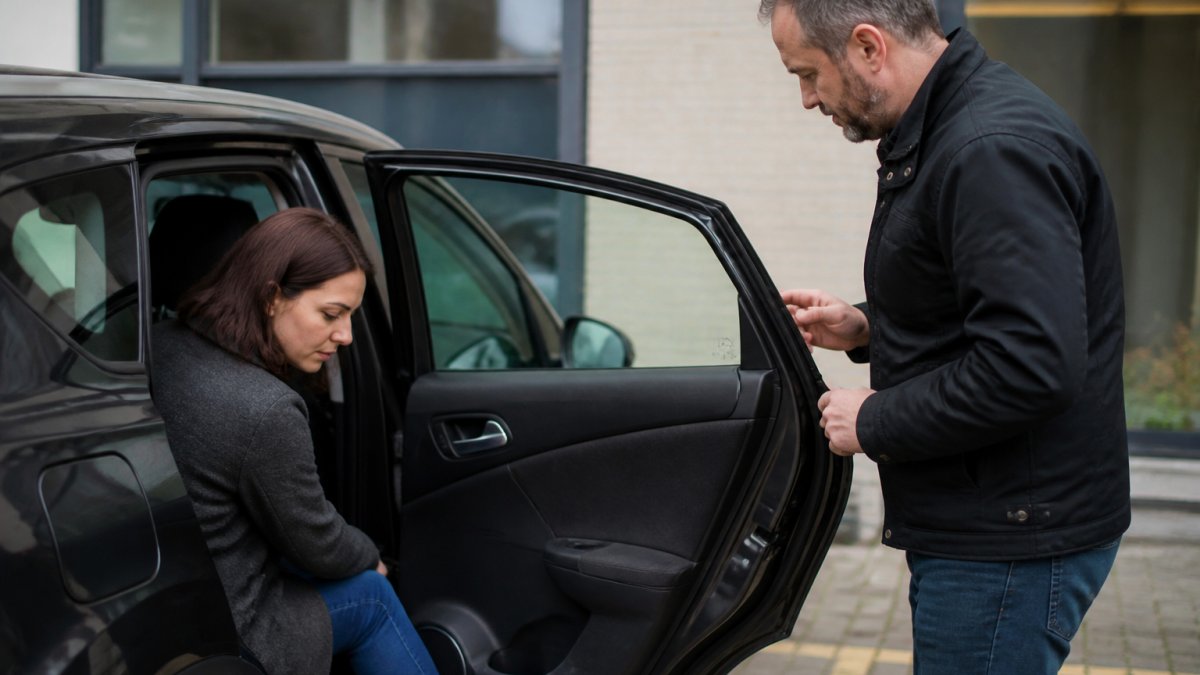
You must have a responsible adult escort you home after IV or oral sedation. This is not a formality. It is a safety requirement, and most clinics will not proceed without it.
Your escort should:
- Be over 18 and not the driver of a taxi or bus
- Collect you in person from the clinic
- Stay with you for the rest of the day
- Know your aftercare instructions
Practical Transport Planning
Sort your transport before treatment day. Leaving it to chance is the most common mistake we see.
A simple plan:
- Book your escort and confirm the time
- Arrange the return journey in advance
- Clear your diary for the rest of the day
- Put your dentist’s contact number in your phone
- Have soft food and water ready at home
If you cannot arrange an escort, tell us when you book. We can discuss whether inhalation sedation is a better fit, or rearrange the appointment.
Driving the Day After Sedation: Is It Safe?
Driving the day after sedation is usually fine, provided a full 24 hours have passed and you feel completely normal. Most people are clear-headed by then.
Check yourself before you drive:
- Do you feel alert and steady?
- Is your vision normal?
- Are you free of drowsiness?
- Would you be comfortable in an emergency?
If any answer is no, wait. There is no prize for rushing back to the wheel.
Legal and Insurance Implications of Driving After Sedation
Driving while impaired by sedatives is an offence (Drugs and driving: the law). If your driving is affected by any drug, including a prescribed sedative, you can be prosecuted.
The practical consequences go further than a fine:
- Your insurance may not cover a claim if you were impaired
- You could face penalty points or a driving ban
- You put yourself and others at real risk
The legal test is whether your driving ability is impaired, not whether you took a legal medicine. Follow your dentist’s advice and the 24-hour rule, and you stay on the right side of it.
Tell your escort to write down your aftercare instructions. Sedation affects short-term memory, so the details you hear in the chair may not stick. A written note from a clear-headed adult is worth more than your own recollection.
What to Do If Sedation Effects Persist
Most sedation effects clear within a day. If they do not, take it seriously.
Contact your dentist or clinic if you notice:
- Drowsiness lasting more than 24 hours
- Confusion or difficulty concentrating
- Dizziness when standing
- Nausea or vomiting that will not settle
- Any reaction that worries you
Do not drive, work with machinery or make important decisions until you feel fully yourself. If symptoms are severe or you have trouble breathing, seek urgent medical help.
If you are planning sedation and want to talk through the driving rules first, book an appointment and we will walk you through it.
Sedation makes dental treatment far more comfortable for nervous patients, but it comes with real responsibilities on the day. If you are unsure whether you can drive after dental sedation in the UK, the safest answer is always to arrange a lift and wait the full 24 hours. Orangefield Dental Care offers pain-free dentistry with flexible opening times, including evenings, and emergency dental services for when you need us quickly. We will talk you through your sedation options, help you plan your journey home and give you clear aftercare advice. Get started with Orangefield Dental Care and book your appointment with confidence.
Frequently Asked Questions
How long does it take to recover from dental sedation?
Recovery time depends on the type of dental sedation used. Inhalation sedation with nitrous oxide typically wears off within minutes of the mask being removed, though you may feel tired for a few hours. Oral sedation can leave you drowsy for four to six hours, and intravenous sedation often requires a full 24 hours before you feel fully alert. Individual factors such as your age, weight, metabolism and the dose given all affect how quickly you recover. Always follow your dentist’s specific aftercare instructions.
Do you need someone to take you home after dental sedation?
Yes. Dental sedation escort requirements mean you must arrange for a responsible adult to collect you from the clinic and stay with you for the rest of the day. This applies to oral and intravenous sedation, and many clinics also recommend it for inhalation sedation. Your escort should not be a taxi driver or a stranger; they need to accompany you inside and monitor you at home. Driving yourself, taking public transport alone or cycling home after sedation is not safe.
Can you drink alcohol after dental sedation?
Avoid alcohol for at least 24 hours after oral or intravenous sedation, and ideally 48 hours. Sedatives and alcohol both depress the central nervous system, and combining them can intensify drowsiness, impair judgement and slow your reaction time. Even a small amount of alcohol can prolong the effects of the sedative and make you feel unwell. If you had inhalation sedation only, wait until you feel completely back to normal before drinking, and never drink on the same day as your treatment.
When can you return to work after dental sedation?
Plan to take the rest of the day off after oral or intravenous sedation. You should not drive, operate machinery, use household appliances or make important decisions for 24 hours. Most people feel ready to return to work the following day, but if you still feel drowsy, foggy or unsteady, wait until those effects have fully cleared. For inhalation sedation, many patients return to work the same day once the effects have worn off, provided their job does not involve driving or hazardous machinery.